

By late July, the San Gabriel Valley has been baking for weeks. Attics run 130°F, garages sit in the low 100s, and the average water heater tank in Glendora is being asked to do the hardest job of the year: deliver hot water without ever really cooling down between draws.
Most homeowners think of water heater failure as a winter problem, a cold snap, a cracked line, a Christmas-morning cold shower. But service data from local plumbing shops across Glendora, CA, Covina, CA, West Covina, CA tells a different story: the late-summer window between mid-July and mid-September is when the most tanks quietly give up.
This guide walks through why that happens, the warning signs to catch in the next 30 days, and how a Glendora, Covina, or West Covina homeowner should think about repair vs. replacement before the tank forces the decision.
Why heat accelerates tank failure
A residential water heater in Glendora, CA spends the summer working two shifts. The first is the obvious one, heating water for showers, laundry, and dishwashing. The second is thermal load from a garage or utility closet that never drops below 90°F.
The anode rod runs out faster
In cooler climates a rod might last 6-8 years. In the Glendora, CA, Covina, CA, West Covina, CA area, tanks left through summer after summer often burn through the anode in 3-4. Once the rod is gone, the tank shell starts to rust from the inside.
Sediment stratifies and bakes
Southern California water is hard. Every gallon that enters your tank leaves a small deposit of calcium carbonate. In summer, when the tank cycles more often, that sediment builds up faster and, with the burner working harder, literally bakes onto the bottom of the tank.
The five warning signs to catch in July
Most tank failures give you 30-60 days of warning. You just have to know what to listen and look for.
Rumbling, popping, or ticking
That sound is water flashing to steam under a layer of sediment. It won’t kill the tank tonight, but it means the tank is running well outside spec and every burner cycle is doing extra damage.
A flush can help if the tank is under 6 years old. Older than that and you’re often better off using the flush to test whether the drain valve still works before deciding on replacement.
Rusty water at the tap
If only the hot side runs discolored, and cold water at the same tap is clear, the source is almost certainly the water heater itself.
Homeowner Reminder
Do not ignore a rumbling tank in July
In Glendora, CA, Covina, CA, West Covina, CA, sediment buildup accelerates through the summer months. A tank that’s rumbling on July 20 is very likely leaking by Halloween. Address it while it’s still a maintenance call, not an emergency.
Repair vs. replacement in a Glendora garage
Not every issue means a new tank. Here is a simple framework we use on every call.
Under 6 years old
The exception is any sign of leakage from the tank body itself, that’s terminal.
Over 10 years old
Almost always worth replacing. Manufacturer warranties are gone, efficiency is 20-30% below current models, and the tank is statistically overdue.
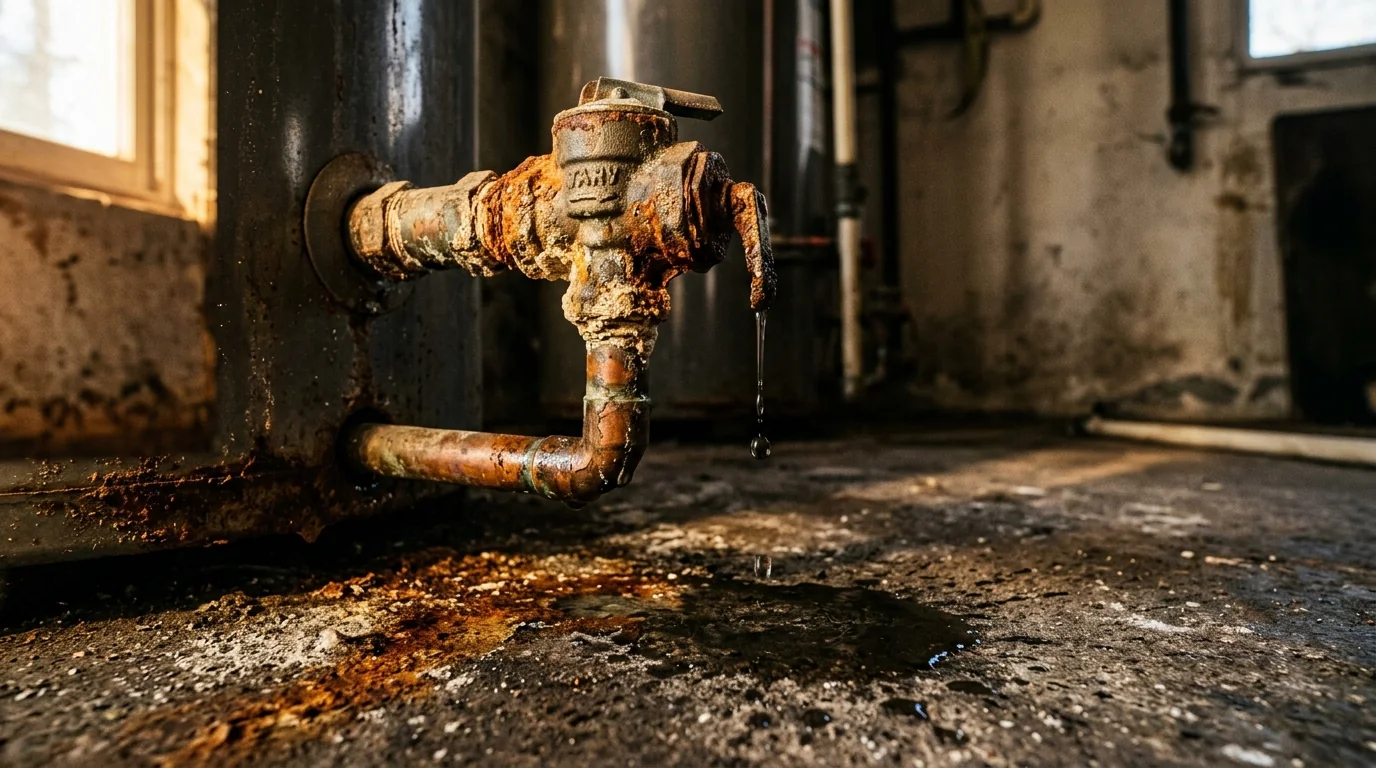
Field detail from a recent Glendora service visit.
Summer-specific maintenance you can do this weekend
Two afternoon jobs, no special tools, will add years to a mid-life tank.
Test the T&P valve
The temperature and pressure relief valve is the tank’s last-resort safety device. Lift the lever, listen for a burst of water into the discharge pipe, then let it snap back.
If nothing comes out, or if it dribbles afterward, the valve is stuck or seated wrong. That’s a same-day fix and a critical one before summer draw peaks. For details, see Commercial Plumbing.
Flush 3-5 gallons from the drain valve
If the water is opaque with grit and takes several minutes to clear, schedule a full flush before Labor Day.
Repair vs. replace at a glance
| Tank Age | Common Issue | Recommended Action |
|---|---|---|
| 0-5 years | Rumbling, minor drips | Flush + anode inspection |
| 5-8 years | Slow recovery, discolored water | Flush, part replacement, plan for tankless |
| 9-12 years | Any leak, corrosion | Replace, tank or tankless |
| 13+ years | Any symptom | Replace immediately, upgrade venting |
When to call for help immediately
Some symptoms are not a wait-until-Monday situation. If you see any of these in the Glendora, CA, Covina, CA, West Covina, CA service area, call a licensed plumber the same day.
Water pooling at the base
A tank body leak is not repairable. Waiting 48 hours often turns a same-day replacement into a slab or subfloor restoration job.
Gas smell or soot on the flue
A gas smell near an appliance is always an emergency, shut the gas off at the tank and call. Soot on the vent hood or a yellow burner flame indicates incomplete combustion and possible carbon monoxide.
Choosing a new tank for the San Gabriel Valley
If replacement is on the table, here’s how to spec correctly for the microclimate.
Size, not just brand
A 40-gallon tank is standard for a two-bath home in Glendora, CA. Three-bath homes with a soaking tub really should be at 50 gallons or on a tankless unit, undersized tanks in a hot climate run harder, which is what we’re trying to avoid.
Location matters more here
That decision is highly home-specific and worth a short conversation with a technician who has seen the layout.
Bottom line for Glendora, CA homeowners
The short version, for anyone scrolling straight to the end: the specifics matter, but the pattern is simple.
What to remember from this guide
Every point above collapses into one idea: the difference between an inexpensive outcome and an expensive one is usually the timing of your first phone call. In Glendora, CA, Covina, CA, West Covina, CA, that decision window is often measured in days, not weeks.
For a topic as location-specific as water heater repair Glendora, the honest advice varies from home to home. What is universally true is that a short conversation with a technician who has worked in your neighborhood is almost always worth the ten minutes.
Why local experience matters in Glendora, CA
Every service area has its own quirks. The layouts, the age of the building stock, the local codes, the climate, none of that is easily transferable from one region to another.
Our team’s day-to-day work runs across Glendora, CA, Covina, CA, West Covina, CA and neighboring communities. That local pattern-recognition is what turns a general recommendation into a specific one for your address.
When you speak with a technician about water heater repair Glendora, ask specifically what they’ve seen in your immediate area over the last twelve months. That question separates local expertise from generic advice, and the answer to it should give you confidence in the path forward.
Need help now?
JG Plumbing & Rooter Inc., 24/7 Plumbing, Rooter, Drain & Sewer, Water Heater, Hydrojetting, Leak Detection and Water Treatment Services. Serving Glendora, CA, Covina, CA, West Covina, CA.
Areas we serve in this coverage: Glendora, CA, Covina, CA, West Covina, CA.
Frequently Asked Questions
How often should I flush my water heater in the San Gabriel Valley?
In hard-water areas like Glendora, Covina, and West Covina, plan on a full flush every 12 months. If you’re on well water or notice popping sounds sooner, twice a year is not overkill.
Is it worth switching to tankless in Glendora?
For most 3+ bedroom homes with garages that reach 100°F in summer, tankless makes strong financial and mechanical sense over a 10-year window because it removes thermal loading, not just fuel cost.
How do I know my anode rod is done?
If your rod hasn’t been replaced in more than 5 years, assume it’s spent. A visual inspection during an annual service call takes 15 minutes and is the single highest-value maintenance step for a hard-water tank.
Can I flush the tank myself?
Yes for a partial flush, attach a hose to the drain valve and run 3-5 gallons into a bucket. A full flush is safer with a technician because a stuck drain valve is one of the most common ways a DIY flush becomes an emergency.
What's the emergency response time in Glendora and Azusa?
For confirmed tank leaks, our team dispatches same day across Glendora, CA, Covina, CA, West Covina, CA. Call 24/7 at (626) 771-5217, evenings and weekends included.
Does homeowner's insurance cover a water heater leak?
Sudden tank failure damage is typically covered; the tank itself is not. Documentation of maintenance (like an annual flush) helps every claim.
JG Plumbing & Rooter Inc., 24/7 Plumbing, Rooter, Drain & Sewer, Water Heater, Hydrojetting, Leak Detection and Water Treatment Services.
Reach us any time at (626) 771-5217.